
Making the decision to have a medication abortion can bring a mix of emotions. Along with relief, you may also feel uncertainty about what to expect once you take the pills. It’s common to search online for answers to questions like, “Am I bleeding too much?” or “Did I take the pills correctly?” Many people worry they’re doing something wrong, especially if it’s their first experience.
Imagine someone named Sarah. She carefully followed her provider’s instructions, stocked up on pads and pain medication, and planned to rest for the weekend. But when the cramping became stronger than she expected, she wondered if something had gone wrong. Should she call someone? Was the bleeding normal? Like many others, Sarah discovered that most of her concerns were part of the expected medication abortion process—not signs that something was wrong.
The good news is that medication abortion is a safe and effective option for ending an early pregnancy when used according to evidence-based medical guidance. Most complications are uncommon, and many of the worries people experience stem from misunderstandings rather than actual emergencies.
Understanding the mistakes to avoid during a medication abortion can help you feel more prepared, reduce unnecessary stress, and recognize when it’s appropriate to seek medical care. This guide explains the most common medication abortion mistakes, offers practical abortion pill tips, and walks you through what to expect before, during, and after taking abortion pills.
Quick Answer
A medication abortion is generally safe and effective when the medications are taken exactly as directed by a qualified healthcare provider. The most important mistakes to avoid include using pills from unverified sources, changing the prescribed dose or timing, skipping preparation, ignoring warning signs such as very heavy bleeding or persistent fever, and missing follow-up care. Understanding what symptoms are normal and when to seek medical attention can help make the experience safer and less stressful.
Mistakes to Avoid During a Medication Abortion Before You Take the First Pill
Preparation plays a bigger role than many people realize. Taking a little time to understand the process before starting can help you feel more confident and make the experience less overwhelming.
Skipping the Instructions Because You Feel Ready
One of the most common medication abortion mistakes is assuming you already know how the medications work.
Every provider may give slightly different instructions depending on your pregnancy duration, medical history, and the medication protocol being used. Reading the instructions thoroughly before taking the first pill allows you to understand:
- When each medication should be taken
- How each medication should be used
- What symptoms are expected
- Which side effects are considered normal
- When you should contact a healthcare provider
Reading everything in advance also helps prevent panic when expected symptoms begin. Instead of wondering whether heavy cramping or passing blood clots is normal, you’ll already know what to anticipate.
Not Confirming That Medication Abortion Is Appropriate for You
Medication abortion is generally recommended during early pregnancy according to current clinical guidance. Before taking abortion pills, it’s important to know how far along the pregnancy is and discuss any medical conditions that could affect your care.
Some situations require additional medical evaluation, including:
- A possible ectopic pregnancy (pregnancy outside the uterus)
- Having an intrauterine device (IUD) in place
- Certain bleeding disorders
- Use of blood-thinning medications
- Known allergies to the medications
These situations don’t automatically mean medication abortion isn’t an option, but they do require guidance from a qualified healthcare professional.
Ordering Medication From Unverified Sources
When searching online, you may come across websites that promise extremely low prices or unusually fast delivery without providing clear information about their medications.
One of the biggest mistakes when taking abortion pills actually happens before the pills ever arrive.
Using medication from an unreliable source increases the risk of receiving counterfeit, expired, or improperly stored products. Trusted providers should clearly explain:
- The medications included
- Instructions for use
- What to expect during the process
- How to access support if questions arise
When possible, check packaging and expiration dates once your medication arrives. Having confidence in your medication can also reduce anxiety during the process.
Medication Abortion Mistakes That Can Affect the Process
Once you’re ready to begin, following the prescribed instructions becomes one of the most important parts of a safe medication abortion.
Changing the Dose or Timing on Your Own
Sometimes people worry they aren’t bleeding enough or think taking extra pills will make the process work faster.
It won’t.
Medication abortion protocols are carefully designed based on extensive research. Taking more medication than instructed—or taking it sooner than recommended—doesn’t necessarily improve effectiveness and may increase unwanted side effects.
Likewise, delaying doses without medical guidance can reduce effectiveness.
The best approach is simple:
- Follow your provider’s schedule.
- Take the medications exactly as instructed.
- Don’t skip doses or change the timing unless advised by a healthcare professional.
If you’re unsure whether you’ve made a mistake, contact your healthcare provider instead of trying to correct it yourself.
Taking the Pills Using the Wrong Method
Another common medication abortion mistake involves using the medication differently than instructed.
Depending on the protocol, misoprostol may be:
- Dissolved between the cheek and gum (buccal)
- Placed under the tongue (sublingual)
- Used vaginally in certain circumstances
Each route has specific instructions regarding timing and absorption.
Swallowing tablets too early or using a different method than instructed may affect how well the medication works.
Always refer to your provider’s abortion pill instructions before beginning.
Taking Medications That May Increase Bleeding
Many people reach for whatever pain reliever they already have at home without realizing that not every medication is equally appropriate during a medication abortion.
For example, aspirin is generally avoided because it can increase bleeding.
Instead, healthcare providers commonly recommend other pain relief options that are more appropriate for managing medication abortion cramps. Always use medications recommended by your provider and avoid adding herbal supplements or over-the-counter products without guidance.
If you have questions about pain management, ask before taking additional medications rather than guessing.
Drinking Alcohol During Heavy Bleeding
Although there isn’t a universal rule prohibiting alcohol after taking abortion pills, many healthcare professionals recommend avoiding alcohol during the period of intense cramping and heavy bleeding.
Alcohol can:
- Increase dehydration
- Make dizziness feel worse
- Mask symptoms that should be monitored
- Make it harder to judge how you’re feeling physically
Hydration is especially important during the medication abortion process.
Water, electrolyte drinks, soups, and other fluids can help you stay comfortable while your body recovers.
Starting Without Preparing Your Recovery Space
Medication abortion often causes stronger cramping and heavier bleeding than a typical menstrual period, especially during the hours after taking misoprostol.
Preparing ahead of time allows you to focus on resting instead of searching for supplies once symptoms begin.
Consider gathering:
- Maxi pads
- Comfortable clothing
- A heating pad or hot water bottle
- Water or electrolyte drinks
- Easy-to-digest meals or snacks
- Pain medication recommended by your provider
- Extra pillows and blankets
- Entertainment like books, movies, or music
- A fully charged phone
Some people also feel reassured having a trusted friend, partner, or family member available, although many complete a medication abortion privately without assistance.
There is no “right” way to approach the experience. The goal is simply to create a calm environment where you can rest comfortably.
Expecting the Process to Look Exactly Like Someone Else’s
One of the biggest sources of anxiety comes from comparing experiences online.
You might read one story describing very heavy bleeding and another describing only moderate bleeding. One person may begin cramping within an hour, while another waits several hours.
These differences are often completely normal.
Every person’s body responds differently.
Factors such as pregnancy duration, individual physiology, and the medication protocol can all influence how symptoms develop.
Instead of comparing yourself with strangers on the internet, focus on whether your own symptoms match the guidance provided by your healthcare provider. Understanding that variation is expected can help reduce unnecessary worry during the process.
Common Medication Abortion Mistakes During Recovery
For many people, the hours after taking misoprostol are when the experience feels the most uncertain. Cramping may become more intense, bleeding may increase, and you might wonder whether everything is progressing as it should.
The reality is that most medication abortions follow a predictable pattern, even though every person’s experience is unique. Knowing what is normal—and what is not—can help you recover with greater confidence.
Panicking Over Symptoms That Are Usually Normal
One of the most common medication abortion mistakes isn’t something you do—it’s assuming that every uncomfortable symptom means something is wrong.
Medication abortion works by causing the uterus to empty its contents, so symptoms like cramping and bleeding are expected. These effects are often strongest within the first several hours after taking misoprostol and usually become lighter over the following days.
Common symptoms include:
- Moderate to heavy bleeding
- Passing blood clots
- Strong cramping
- Fatigue
- Nausea
- Vomiting
- Diarrhea
- Chills
- A temporary low-grade fever shortly after taking misoprostol
These symptoms can feel alarming if you aren’t expecting them, but they are often part of the normal process.
If you’re unsure how your recovery is progressing, learning about abortion recovery signs can help you understand what healing commonly looks like from day one through the following weeks.
Ignoring Symptoms That Need Medical Attention
While serious complications are uncommon, it’s important not to dismiss symptoms that could indicate a problem.
Contact a healthcare provider or seek emergency medical care if you experience:
- Very heavy bleeding, such as soaking through two or more large maxi pads per hour for two consecutive hours
- Severe abdominal pain that doesn’t improve with recommended pain medication
- A fever that develops later or persists beyond the expected timeframe
- Foul-smelling vaginal discharge
- Fainting or severe weakness
- Difficulty breathing
- Symptoms of a possible ectopic pregnancy, such as severe one-sided abdominal pain, shoulder pain, or dizziness
Being aware of these warning signs isn’t meant to create fear—it’s part of practicing good medication abortion safety.
Normal Symptoms vs. Warning Signs
Remember, knowing when to ask for help is just as important as knowing what to expect.
Skipping Your Follow-Up
Some people assume that once the bleeding slows down, the medication abortion is complete.
However, follow-up is still an important part of the process.
Depending on your provider’s recommendations, follow-up may include:
- A home pregnancy test after the recommended waiting period
- A symptom check
- An ultrasound if advised
- A telehealth or in-person follow-up appointment
This helps confirm that the pregnancy has ended successfully and that no additional treatment is needed.
Following through with aftercare provides reassurance and allows any concerns to be addressed promptly.
Mistakes to Avoid During a Medication Abortion After Taking Abortion Pills
Recovery continues after the heaviest bleeding has passed. The choices you make over the next several days can support both comfort and healing.
Using Tampons or Menstrual Cups Too Soon
Many healthcare providers recommend using sanitary pads instead of tampons or menstrual cups while bleeding heavily.
Pads make it easier to:
- Monitor how much you’re bleeding
- Notice changes over time
- Reduce irritation while your body recovers
Once your provider says it’s appropriate, you can return to your usual menstrual products.
Returning to Intense Exercise Too Quickly
You don’t have to stay in bed for days, but your body has been through an important physical process.
Light walking may feel comfortable for many people, while strenuous exercise, heavy lifting, or high-impact workouts may be better postponed until heavy bleeding slows and you feel ready.
Listening to your body is often the best guide.
Forgetting Everyday Self-Care
Recovery isn’t only about waiting for bleeding to stop.
Supporting your body can make the experience more manageable.
Helpful abortion self-care tips include:
- Drinking plenty of water
- Getting enough sleep
- Using a heating pad for cramping
- Wearing comfortable clothing
- Taking medications exactly as directed
- Asking for emotional support if you want it
- Giving yourself permission to rest
Nutrition also plays a role.
Many people find that light, nourishing meals are easier to tolerate during recovery. Warm soups, toast, oatmeal, bananas, rice, yogurt, eggs, and iron-rich foods may help replenish energy, especially after heavier bleeding.
You can also explore comfort foods in abortion that focus on gentle meals and hydration to support recovery.
For additional guidance beyond the first few days, reading about abortion Aftercare and practical abortion recovery tips can help you feel prepared for the weeks ahead.
What Many People Worry About—But Usually Don’t Need To
Even after following every instruction correctly, many people still have lingering questions.
“Did I Bleed Too Much?”
Bleeding is often heavier than a menstrual period during the medication abortion process.
Heavy bleeding alone doesn’t necessarily mean something is wrong.
The amount can vary significantly between individuals. The important factor is whether it remains within expected limits and gradually improves over time.
“My Symptoms Started Earlier (or Later) Than Expected.”
The timing of cramping and bleeding varies.
Some people begin experiencing symptoms within an hour after taking misoprostol, while others may wait several hours.
Both experiences can be normal.
“Will This Affect My Ability to Have Children Later?”
Current medical evidence shows that a properly managed medication abortion does not generally reduce future fertility.
Many people become pregnant again in the future if they choose to.
If you do not wish to become pregnant immediately afterward, discuss contraception options with your healthcare provider, as ovulation can return relatively quickly.
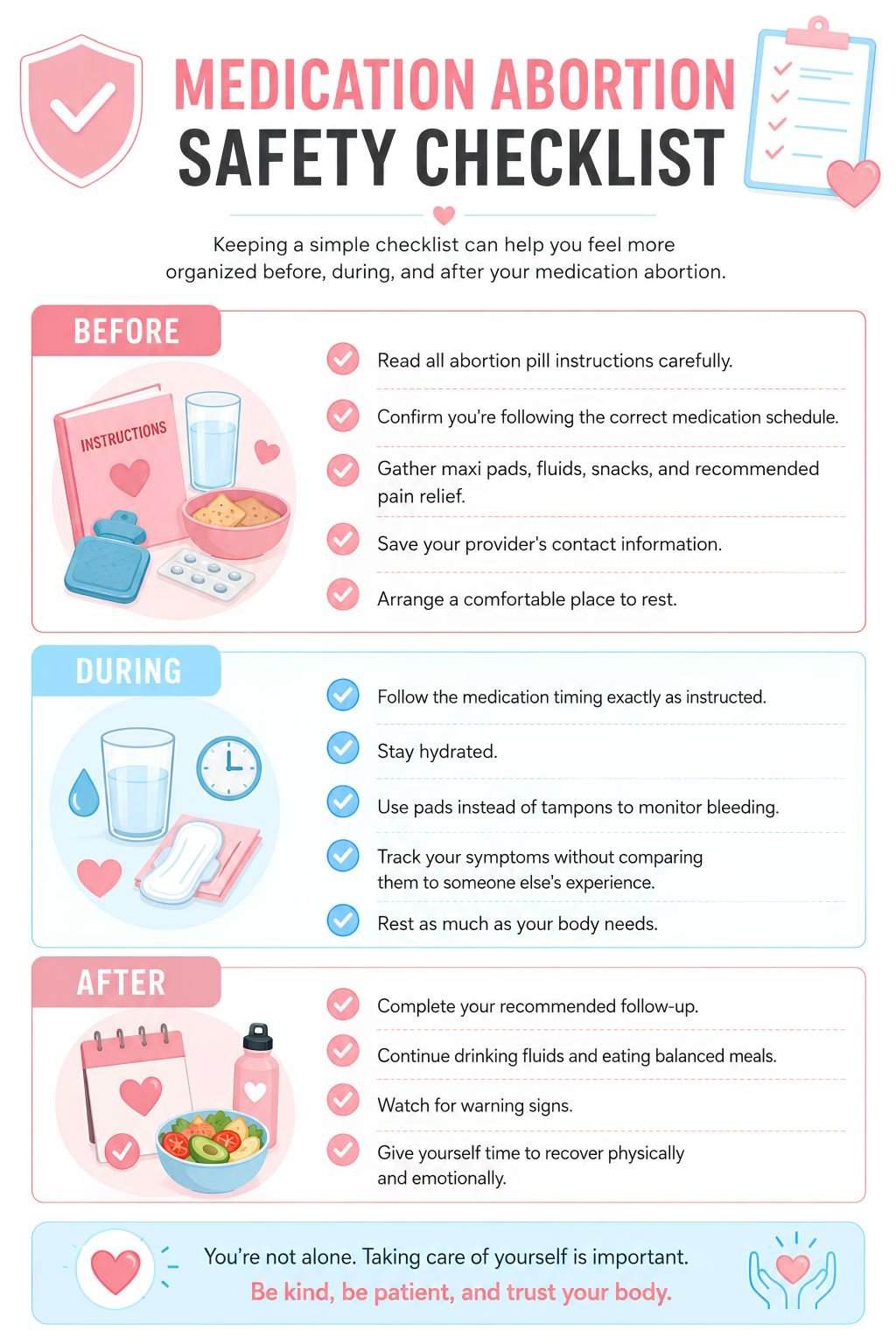
Medication Abortion Safety Checklist
Keeping a simple checklist can help you feel more organized before, during, and after your medication abortion.
Before
✔ Read all abortion pill instructions carefully.
✔ Confirm you’re following the correct medication schedule.
✔ Gather maxi pads, fluids, snacks, and recommended pain relief.
✔ Save your provider’s contact information.
✔ Arrange a comfortable place to rest.
During
✔ Follow the medication timing exactly as instructed.
✔ Stay hydrated.
✔ Use pads instead of tampons to monitor bleeding.
✔ Track your symptoms without comparing them to someone else’s experience.
✔ Rest as much as your body needs.
After
✔ Complete your recommended follow-up.
✔ Continue drinking fluids and eating balanced meals.
✔ Watch for warning signs.
✔ Give yourself time to recover physically and emotionally.
When It’s Time to Seek Immediate Medical Care
Although serious complications are rare, seek urgent medical attention if you experience:
- Very heavy bleeding that meets emergency criteria
- Severe abdominal pain that continues to worsen
- Persistent or high fever
- Difficulty breathing
- Fainting
- Severe weakness
- Suspected ectopic pregnancy symptoms
Prompt medical care can ensure you receive the evaluation and treatment you need.
You Don’t Have to Figure It Out Alone
One of the biggest sources of stress during a medication abortion isn’t always the physical symptoms—it’s uncertainty.
Many people spend hours searching online because they’re unsure whether what they’re experiencing is normal. Having clear instructions and access to reliable support can make a meaningful difference.
At Abortion Pills in Private, the goal is to provide more than discreet medication delivery. Every order includes step-by-step abortion pill instructions, guidance on what to expect before and after taking the medications, and ongoing support to help answer common questions throughout the process.
Whether you’re preparing for treatment or looking for reliable information during recovery, having access to trusted guidance can help you feel more informed and confident every step of the way.
Frequently Asked Questions
What are the biggest mistakes to avoid during a medication abortion?
The most common mistakes include using medication from an unverified source, changing the prescribed dose or timing, skipping preparation, taking aspirin without medical advice, ignoring warning signs, and not completing recommended follow-up care.
Can taking abortion pills incorrectly make them less effective?
Yes. Changing the dose, timing, or method of taking the medication may reduce effectiveness. Always follow the instructions provided by your healthcare provider.
What should I avoid after taking abortion pills?
Avoid using tampons or menstrual cups during heavy bleeding, taking aspirin unless instructed, drinking excessive alcohol during intense symptoms, and returning to strenuous exercise before your body feels ready.
Is heavy bleeding always a sign that something is wrong?
No. Heavy bleeding is an expected part of most medication abortions. However, soaking through two or more large maxi pads per hour for two consecutive hours is considered a warning sign and requires medical attention.
How do I know if my medication abortion worked?
Your healthcare provider may recommend a follow-up pregnancy test, symptom assessment, or ultrasound, depending on your situation. Completing follow-up helps confirm that the abortion is complete.
When should I seek emergency care?
Seek immediate medical care if you experience very heavy bleeding, severe pain that doesn’t improve, persistent fever, fainting, difficulty breathing, or symptoms suggestive of an ectopic pregnancy.
Key Takeaways
- Follow your healthcare provider’s abortion pill instructions exactly as prescribed.
- Only obtain abortion pills from trusted, reputable providers to help ensure medication quality and safety.
- Prepare your recovery space with essentials such as maxi pads, a heating pad, fluids, and recommended pain relief before taking the medication.
- Avoid changing the dose, timing, or method of taking the pills without medical guidance.
- Do not take aspirin for pain relief unless specifically instructed, as it may increase bleeding.
- Use sanitary pads instead of tampons or menstrual cups during heavy bleeding so you can better monitor blood loss.
- Mild to heavy bleeding, cramping, passing clots, nausea, and temporary chills are common parts of the medication abortion process.
- Seek immediate medical care if you experience very heavy bleeding, severe pain that doesn’t improve, persistent fever, fainting, or foul-smelling vaginal discharge.
- Complete any recommended follow-up to confirm the medication abortion was successful.
- Prioritize rest, hydration, nutritious meals, and self-care to support a comfortable recovery.
Conclusion
When Sarah looked back on her experience, she realized that most of the moments that caused her the greatest anxiety were actually normal parts of the medication abortion process. The preparation she had done—and knowing when to seek help—made all the difference.
The same is true for many people. Understanding the mistakes to avoid during a medication abortion isn’t about creating fear; it’s about helping you feel informed, prepared, and supported. Following your provider’s instructions, recognizing the difference between expected symptoms and warning signs, and giving yourself time to recover can contribute to a smoother experience.
Remember that every body responds differently, and your recovery doesn’t have to look exactly like someone else’s. Trust evidence-based guidance, be patient with yourself, and don’t hesitate to reach out to a healthcare professional if something doesn’t feel right. Being informed is one of the best ways to approach a medication abortion with greater confidence and peace of mind.
Disclaimer: This article is for informational purposes only and should not replace personalized medical advice. Abortion laws vary by state and may change over time. Always follow the instructions provided by your healthcare provider.
About the Author

Caroline*
Caroline M. Hayes is a healthcare content specialist and writer with a focus on women’s health and patient education. With experience across telehealth and in-person care environments, she creates content that helps individuals better understand their health and make informed decisions with confidence.
Her work focuses on simplifying complex medical topics into clear, accessible, and easy-to-understand information—especially in areas that require sensitivity, privacy, and clarity. She contributes to educational resources designed to support individuals navigating important health choices.
Caroline’s approach combines accuracy, empathy, and clarity, ensuring that health information is both reliable and approachable for a wide audience.
Outside of her professional work, she enjoys yoga, reading, and caring for her growing collection of plants.
All content is created for informational purposes and reviewed to ensure clarity and accuracy
*Name has been changed to protect privacy.*