
Medication abortion is highly effective for ending an early pregnancy, but in a small number of cases, the process may not work exactly as expected. When this happens, it can feel confusing, stressful, and emotionally overwhelming — especially if symptoms seem different from what you were told to expect.
If you are worried about a failed abortion pill experience, it is important to know that safe medical options are available. Many people who experience ongoing symptoms simply need follow-up care, additional medication, or a brief procedure to complete the process safely.
Understanding what is normal, what may signal a problem, and what to do when abortion pills fails can help reduce fear and make the recovery process feel more manageable.
Quick Summary
- Abortion pills are highly effective, but in rare cases the abortion may be incomplete or the pregnancy may continue.
- Common signs abortion pills did not work include little or no bleeding, ongoing pregnancy symptoms, severe cramping, or a positive pregnancy test after several weeks.
- Incomplete abortion symptoms may include heavy bleeding, pelvic pain, fever, chills, or foul-smelling discharge.
- If abortion pills fail, medical follow-up is important to confirm whether the abortion is complete.
- Treatment options may include another dose of misoprostol, monitoring, or a minor procedure like vacuum aspiration or D&C.
- Seek emergency care immediately for severe pain, soaking through 2 pads per hour for 2 consecutive hours, dizziness, fainting, or fever lasting over 24 hours.
- Most failed medication abortion cases can be treated safely, and needing additional care does not mean you did anything wrong.
What to Do When Abortion Pills Fails: Understanding What It Means
Before assuming something has gone wrong, it helps to understand what healthcare providers mean when they talk about abortion pill failure.
In most cases, medication abortion works successfully without complications.
However, there are rare situations where:
- The pregnancy continues
- Some pregnancy tissue remains in the uterus
- The body responds more slowly than expected
Not every unusual symptom automatically means the abortion failed. Some people bleed heavily within hours, while others experience lighter bleeding that gradually increases later.
What Counts as a Failed Medication Abortion?
A medication abortion is generally considered unsuccessful in two situations:
Ongoing Pregnancy
The pregnancy continues developing after taking the medications.
Incomplete Abortion
The pregnancy ended, but some tissue remains inside the uterus.
Both situations require follow-up medical evaluation, but they are usually treatable with safe and effective care.
A medical abortion failed situation can feel alarming emotionally, especially if symptoms are unclear. Many people worry they did something wrong, but this is rarely the case. Bodies respond differently to medication, and occasional treatment failure can happen even when instructions are followed correctly.
How Effective Are Abortion Pills?
The combination of mifepristone and misoprostol is highly effective during early pregnancy.
For pregnancies under 10–11 weeks, success rates are generally around 95–99% when the medications are used correctly.
Several factors can affect effectiveness, including:
- Gestational age
- Timing of medication
- Dosage accuracy
- Individual body response
- Medication quality
Even though an abortion pill failure situation is uncommon, follow-up care remains an important part of safe abortion management.
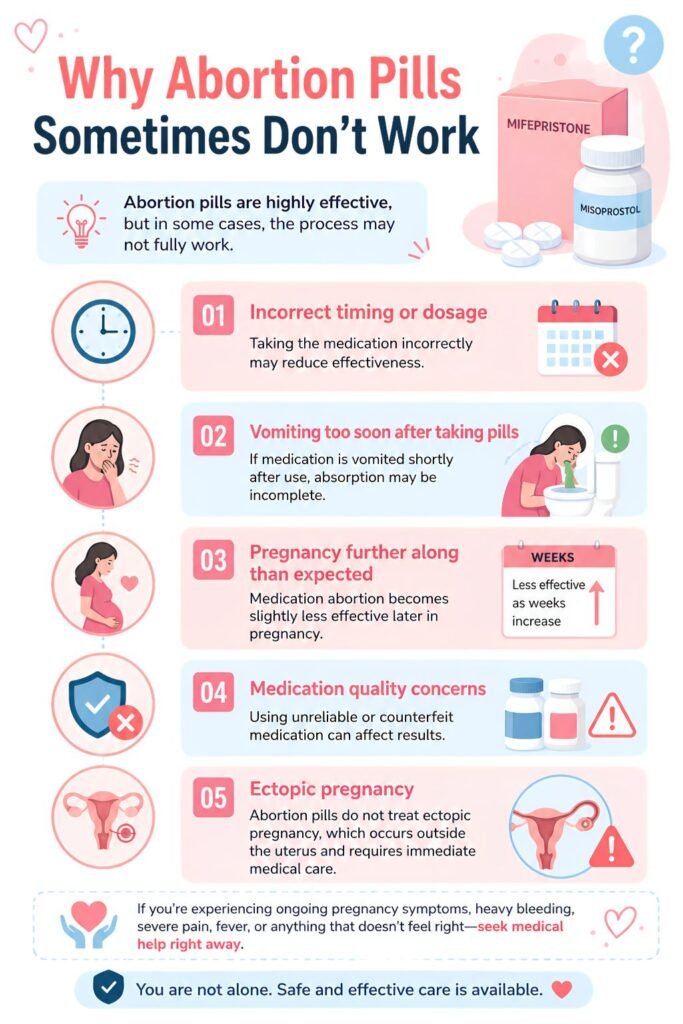
Why Abortion Pills Sometimes Don’t Work
There are several possible reasons why abortion pills may not fully work.
Incorrect timing or dosage
Taking the medication incorrectly may reduce effectiveness.
Vomiting too soon after taking pills
If medication is vomited shortly after use, absorption may be incomplete.
Pregnancy further along than expected
Medication abortion becomes slightly less effective later in pregnancy.
Medication quality concerns
Using unreliable or counterfeit medication can affect results.
Ectopic pregnancy
Abortion pills do not treat ectopic pregnancy, which occurs outside the uterus and requires immediate medical care.
Understanding these factors can help explain why some people later search for answers about abortion pills not working or ongoing pregnancy symptoms.
Why Follow-Up Care Matters
Many people assume that once bleeding begins, the process is complete. However, symptoms alone do not always confirm success.
Healthcare providers may recommend:
- A pregnancy test after several weeks
- Ultrasound examination
- Blood testing
- Symptom review
Following a proper Abortion Pill Timeline helps people understand when symptoms usually begin, peak, and improve.
Needing additional follow-up does not mean your experience is abnormal. In fact, careful monitoring is part of responsible reproductive healthcare.
Signs Abortion Pill Did Not Work
One of the most common concerns after medication abortion is understanding whether symptoms are normal or whether something may need medical attention.
Because recovery varies from person to person, it can sometimes be difficult to tell the difference between delayed symptoms and a possible failed abortion.
Little or No Bleeding After Taking Misoprostol
Most people begin bleeding within a few hours after taking misoprostol. The bleeding is often heavier than a regular period and may include blood clots.
If there is:
- No bleeding
- Only very light spotting
- Minimal cramping
within 24–48 hours, it may suggest the medication did not fully work.
However, some people experience delayed bleeding, so this symptom alone does not automatically confirm failure.
Pregnancy Symptoms Continue After Treatment
Persistent pregnancy symptoms can sometimes indicate an ongoing pregnancy.
Possible symptoms include:
- Nausea
- Breast tenderness
- Fatigue
- Food aversions
- Frequent urination
Many pregnancy symptoms begin improving within several days after a successful abortion, although hormone levels may take time to fully decline.
If you are concerned about hormonal changes during recovery, read: Does abortion pill affect hormones
Positive Pregnancy Test Weeks Later
Pregnancy hormones can remain in the body for several weeks after a successful abortion.
However, if:
- A pregnancy test remains strongly positive after 3–4 weeks
- Pregnancy symptoms continue
- Bleeding was extremely minimal
a healthcare provider may recommend evaluation.
This is one of the most common reasons people begin researching how to know abortion pills failed.
Incomplete Abortion Symptoms to Watch For
An incomplete abortion happens when some pregnancy tissue remains inside the uterus.
Possible incomplete abortion symptoms include:
- Persistent heavy bleeding
- Severe cramping
- Fever or chills
- Pelvic pain
- Foul-smelling discharge
- Weakness or dizziness
If untreated, retained tissue may increase the risk of infection or prolonged bleeding.
While these symptoms can sound frightening, treatment is usually very effective once the issue is identified.
When Symptoms May Still Be Normal
Recovery after abortion pills is not identical for everyone.
Some people:
- Bleed heavily for a few hours
- Have lighter bleeding for several days
- Pass clots later in the process
- Experience intermittent cramping for up to two weeks
These variations are often normal.
If you are unsure what recovery usually looks like, read: What to Expect After Taking the Abortion Pill
What Happens If Abortion Pills Don’t Work?
If symptoms suggest the medication abortion may not have been successful, the next step is medical evaluation.
Although this situation can feel emotionally overwhelming, treatment is usually straightforward and highly effective.
Healthcare providers typically confirm what is happening through:
- Ultrasound examination
- Blood tests measuring pregnancy hormone levels
- Physical symptom review
These evaluations help determine whether:
- The pregnancy is ongoing
- Tissue remains inside the uterus
- The abortion completed normally
- Another condition is present
In the next section, we’ll discuss what to do if abortion pills fail, treatment options that may be recommended, and when emergency care is necessary.
What to Do If Abortion Pills Fail: Medical Treatment Options
Learning that a medication abortion may not have worked completely can feel upsetting, especially after already going through cramping, bleeding, and emotional stress. However, most incomplete or ongoing pregnancies can be safely treated once the issue is identified.
The right treatment depends on:
- Your symptoms
- Ultrasound findings
- How far along the pregnancy is
- Whether tissue remains inside the uterus
- Your overall health and comfort level
Understanding your options can make the process feel less frightening and more manageable.
Taking Another Dose of Misoprostol
In some cases, healthcare providers may recommend an additional dose of misoprostol.
This option is often considered when:
- Bleeding was very light
- Ultrasound shows retained tissue
- The pregnancy appears partially expelled
- There are no signs of infection or emergency complications
Misoprostol helps the uterus contract and push out remaining tissue.
After another dose, many people experience:
- Increased cramping
- Heavier bleeding
- Passage of clots
- Temporary nausea or diarrhea
These symptoms can feel physically draining, but they are often part of the body completing the process.
People who are already familiar with the normal side effects of abortion pills may feel less anxious about temporary cramping and bleeding after repeat medication treatment.
Vacuum Aspiration or D&C Procedures
If medication alone does not fully complete the abortion, a provider may recommend a minor procedure such as:
- Vacuum aspiration
- Dilation and curettage (D&C)
These procedures are very common and are typically completed quickly in a clinic or healthcare setting.
Vacuum Aspiration
A small suction device is used to remove tissue from the uterus.
D&C (Dilation and Curettage)
The cervix is gently opened so remaining tissue can be removed safely.
Many people feel nervous when hearing the word “surgery,” but these procedures are generally brief, effective, and medically routine.
Healthcare providers may recommend surgical treatment when:
- Heavy bleeding continues
- Infection is suspected
- Pregnancy remains ongoing
- Retained tissue is significant
- Pain becomes severe
A failed medical abortion treatment does not mean your body is damaged or that future fertility is affected. In most cases, recovery is smooth once treatment is completed.
Expectant Management: Waiting for the Body to Pass Tissue Naturally
In carefully selected situations, a provider may recommend monitoring symptoms for a short period rather than immediately giving medication or performing a procedure.
This approach is called expectant management.
It may be considered if:
- Only a small amount of tissue remains
- Bleeding is stable
- There are no infection symptoms
- Pain is manageable
Some people naturally pass remaining tissue over time without additional intervention.
However, close monitoring is important because symptoms can change. Follow-up appointments or testing may still be necessary to confirm the uterus has fully cleared.
Which Treatment Option Is Best?
There is no single answer that works for everyone.
The best option depends on:
- Your symptoms
- Ultrasound findings
- Gestational age
- Personal comfort
- Medical history
- Bleeding severity
Some people prefer medication to avoid a procedure, while others choose surgical treatment for faster resolution and peace of mind.
A trusted healthcare provider can help explain the risks, benefits, and expected recovery for each option.
Access to reliable abortion care, accurate medication guidance, and supportive follow-up can make the entire experience feel safer and less overwhelming.
Emergency Symptoms That Need Immediate Medical Attention
Although serious complications are uncommon, certain symptoms should never be ignored.
If something feels severe, worsening, or different from what you expected, seeking medical attention is the safest decision.
Heavy Bleeding
Bleeding is normal after abortion pills, but extremely heavy bleeding may require emergency care.
Seek urgent help if you:
- Soak through 2 large pads per hour for 2 consecutive hours
- Feel faint or dizzy
- Notice very large clots repeatedly
Heavy bleeding can sometimes signal retained tissue or hemorrhage.
Severe Abdominal or One-Sided Pain
Strong cramping is expected during medication abortion, but severe pain that does not improve with medication may require evaluation.
One-sided abdominal pain can sometimes signal ectopic pregnancy, which is a medical emergency.
Emergency symptoms may include:
- Shoulder pain
- Fainting
- Dizziness
- Sharp pelvic pain
Fever, Chills, or Foul-Smelling Discharge
These symptoms may indicate infection.
Warning signs include:
- Fever over 100.4°F lasting more than 24 hours
- Chills
- Increasing pelvic pain
- Foul-smelling vaginal discharge
Infections are treatable, but prompt care is important.
Dizziness, Weakness, or Fainting
These symptoms may occur with:
- Significant blood loss
- Dehydration
- Infection
- Severe pain
If you feel weak, confused, or unable to stand safely, seek medical care immediately.
Recovery After an Abortion Pill Failed Experience
Recovery after additional treatment is usually straightforward, although emotional recovery may take longer for some people.
Many individuals feel physically better within days after treatment is completed.
Physical Recovery Timeline
Recovery varies from person to person, but common experiences include:
- Light bleeding for several days or weeks
- Mild cramping
- Fatigue
- Hormonal shifts
Most symptoms gradually improve over time.
Following the expected Abortion Pill Timeline can help you better understand when bleeding and cramping typically decrease.
Does Abortion Pill Affect Hormones Afterward?
Hormone levels change naturally after pregnancy ends.
Some people notice:
- Mood swings
- Breast tenderness
- Fatigue
- Temporary emotional sensitivity
These changes are usually temporary as hCG levels decline.
If you want a more detailed explanation, read: Does abortion pill affect hormones
Can the Abortion Pill Affect Fertility?
One of the most common fears after a difficult abortion experience is future fertility.
Current medical evidence shows that medication abortion generally does not affect long-term fertility.
Ovulation can return quickly, sometimes within a few weeks.
If future pregnancy is important to you, learning more about Can the Abortion Pill Affect Fertility may help provide reassurance.
Emotional Recovery Matters Too
People respond emotionally in very different ways after a failed or incomplete abortion.
Some feel:
- Relief
- Anxiety
- Frustration
- Sadness
- Emotional exhaustion
All of these reactions can be normal.
Rest, hydration, emotional support, and time can all help during recovery.
How to Reduce the Risk of Abortion Pills Not Working
Although no method is 100% guaranteed, several steps may help improve effectiveness and reduce complications.
Follow Medication Instructions Carefully
Correct timing and dosage matter significantly.
This includes:
- Taking medication exactly as directed
- Following proper timing intervals
- Understanding buccal or sublingual use instructions
Confirm Pregnancy Timing
Medication abortion is generally most effective earlier in pregnancy.
Understanding gestational age before treatment can help improve success rates.
Use Trusted Providers and Reliable Medication Sources
Reliable medication quality matters.
Working with trusted providers or reputable telehealth services may reduce the risk of incorrect dosing or counterfeit medication concerns.
Don’t Skip Follow-Up Testing
Even if symptoms seem normal, follow-up pregnancy testing remains important.
This helps confirm the abortion completed successfully and reduces the risk of untreated complications.
Conclusion
Experiencing a situation where abortion pills do not work as expected can feel emotionally and physically overwhelming. However, most incomplete or ongoing pregnancies can be safely managed with proper medical care.
Understanding the warning signs, knowing when to seek help, and following up promptly can protect both your health and peace of mind.
Most importantly, needing additional care does not mean you failed or did something wrong. Medication abortion experiences vary from person to person, and safe treatment options are available if the process does not fully complete the first time.
About the Author

Caroline
Caroline M. Hayes is a healthcare content specialist and writer with a focus on women’s health and patient education. With experience across telehealth and in-person care environments, she creates content that helps individuals better understand their health and make informed decisions with confidence.
Her work focuses on simplifying complex medical topics into clear, accessible, and easy-to-understand information—especially in areas that require sensitivity, privacy, and clarity. She contributes to educational resources designed to support individuals navigating important health choices.
Caroline’s approach combines accuracy, empathy, and clarity, ensuring that health information is both reliable and approachable for a wide audience.
Outside of her professional work, she enjoys yoga, reading, and caring for her growing collection of plants.
All content is created for informational purposes and reviewed to ensure clarity and accuracy