
When facing an unexpected pregnancy, one of the most common questions people ask is: Is the abortion pill safer than surgical abortion?
The short answer is that both medication abortion and surgical abortion are considered extremely safe and effective. However, they work differently, involve different experiences, and carry different risks and benefits. For many people, the “safer” option depends less on the procedure itself and more on personal circumstances, medical history, pregnancy stage, and comfort level.
Understanding the differences can help you make a more informed decision and feel more confident about your choice. Whether you’re looking for privacy at home, immediate completion, fewer follow-up appointments, or a particular recovery experience, knowing how each option compares is essential.
In this guide, we’ll explore the facts behind abortion pill vs surgical abortion, including safety, effectiveness, side effects, recovery, and the situations in which one option may be preferred over the other.
Quick Summary
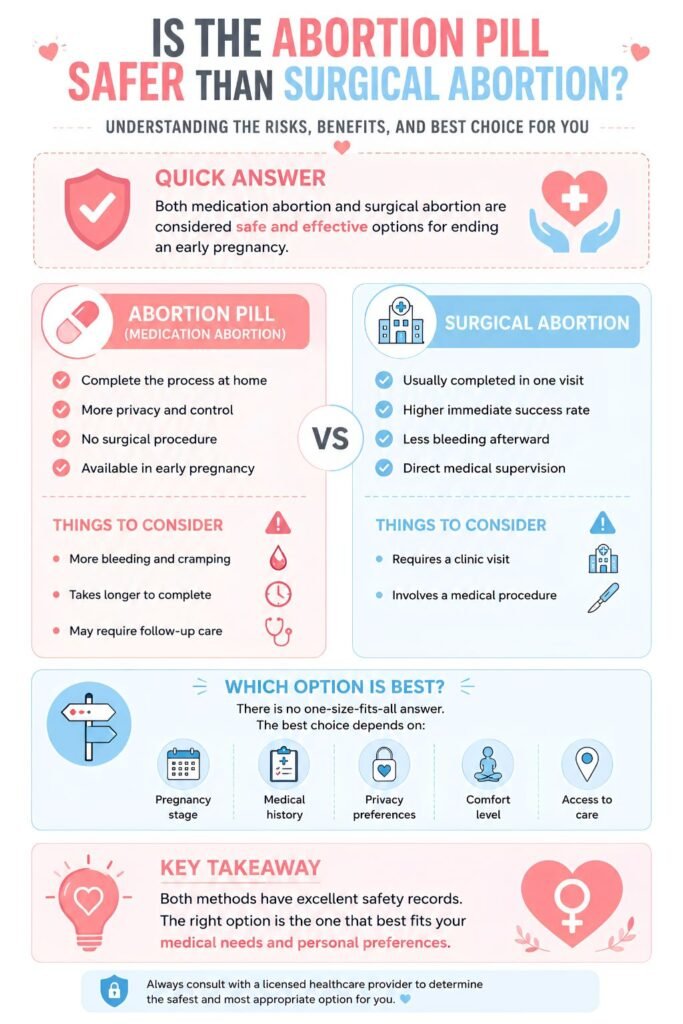
Both the abortion pill (medication abortion) and surgical abortion are extremely safe and effective options for ending an early pregnancy. Neither method is universally safer than the other, as each has its own advantages and risks. Medication abortion offers privacy, convenience, and avoids a surgical procedure, while surgical abortion provides faster completion, higher effectiveness, and immediate medical supervision. Understanding the differences in safety, effectiveness, side effects, and recovery can help you choose the option that best fits your medical needs and personal preferences.
Abortion Pill vs Surgical Abortion: Understanding the Two Main Abortion Methods
Before comparing safety, it’s important to understand how each method works.
What Are Abortion Pills and How Do They Work?
Medication abortion, often called the abortion pill, uses two medications to end a pregnancy.
The first medication, mifepristone, blocks progesterone, a hormone necessary for pregnancy to continue. The second medication, misoprostol, causes the uterus to contract and expel the pregnancy tissue.
If you’re unfamiliar with the medications involved, you can learn more in our guide on What Are Abortion Pills and What Pills Are Used for Abortions.
The process typically takes place at home and may feel similar to a miscarriage. Most people begin experiencing cramping and bleeding within a few hours after taking misoprostol.
Medication abortion is generally available during early pregnancy and is often chosen by people who prefer privacy and greater control over where the process occurs.
How Does Surgical Abortion Work?
Surgical abortion, also known as procedural abortion or aspiration abortion, is performed in a medical setting by a trained healthcare provider.
During the procedure, gentle suction is used to remove pregnancy tissue from the uterus. Depending on the stage of pregnancy and clinic protocols, local anesthesia, sedation, or other pain-management options may be available.
Unlike medication abortion, which occurs over several hours or days, surgical abortion is usually completed in a single visit and often takes only a few minutes.
Many people appreciate the predictability of a procedure completed under medical supervision, while others prefer the privacy and familiarity of managing the process at home.
Key Differences at a Glance
While both methods are highly effective, they offer different experiences.
Medication abortion generally involves:
- Taking medications rather than undergoing a procedure
- Completing the process at home
- More bleeding and cramping during the abortion process
- A slightly higher chance of requiring follow-up treatment
- Greater privacy for some patients
Surgical abortion generally involves:
- An in-clinic procedure
- Immediate completion
- Less prolonged bleeding afterward
- Direct medical supervision throughout the process
- Higher overall completion rates
Understanding these differences helps explain why some people prefer one option over the other—even though both are considered safe.
Is the Abortion Pill Safer Than Surgical Abortion? What the Evidence Shows
The question isn’t always straightforward because safety can be measured in different ways.
Some people define safety as avoiding surgery and anesthesia. Others define it as having the lowest chance of needing additional treatment. Still others prioritize access to medical professionals during the process.
The Overall Safety of Both Methods
Research consistently shows that both medication abortion and surgical abortion are among the safest medical interventions available.
Serious complications are rare with either method, especially during the first trimester.
According to the American College of Obstetricians and Gynecologists, medication abortion is a safe and effective method, and abortion in general has very low complication rates. However, incomplete abortion is more likely after medication abortion than after a procedural abortion, while injuries to the uterus or surrounding organs are risks specific to procedures.
This distinction is important because it highlights that each option has its own risk profile rather than proving one method is universally safer.
Why “Safer” Means Different Things to Different People
For someone who wants to avoid medical instruments entering the uterus, medication abortion may feel like the safer choice.
For someone who wants the highest likelihood of completing the abortion in a single visit, surgical abortion may feel safer.
Factors that can influence the decision include:
- How far along the pregnancy is
- Previous medical conditions
- Access to follow-up care
- Personal comfort with medical procedures
- Desire for privacy
- Need for scheduling flexibility
Many healthcare providers encourage patients to focus on which option best aligns with their individual circumstances rather than searching for a universally superior choice.
What Medical Experts Commonly Recommend
Most medical organizations do not identify one method as categorically safer than the other.
Instead, they emphasize that both medication abortion and surgical abortion have excellent safety records when performed according to established medical guidelines.
This can be reassuring for people who feel overwhelmed by conflicting information online. The reality is that both options have been extensively studied and used safely by millions of patients.
Medication Abortion vs Surgical Abortion: Comparing Risks and Complications
Although serious complications are uncommon, understanding the differences can help set realistic expectations.
Medical Abortion vs Surgical Abortion Risks
One of the most significant differences involves the possibility of an incomplete abortion.
Medication abortion is highly effective, but in a small percentage of cases, the pregnancy may continue or some tissue may remain in the uterus. When this occurs, additional medication or a surgical procedure may be necessary.
This does not mean the abortion pill is unsafe. Rather, it reflects the fact that medication abortion relies on the body’s natural process to complete the abortion.
If you’re concerned about this possibility, our guide on What to Do When Abortion Pills Fails explains what signs to watch for and what next steps may be recommended.
Risks Unique to Surgical Procedures
Surgical abortion has its own unique risks, although they remain rare.
Because medical instruments are used inside the uterus, there is a small possibility of:
- Uterine perforation
- Cervical injury
- Infection
- Complications related to anesthesia or sedation
These complications occur infrequently, particularly when procedures are performed by experienced providers.
The vast majority of patients recover without experiencing serious issues.
Serious Complications Remain Rare
An important takeaway is that both medication abortion and surgical abortion have very low rates of serious complications.
For most people, the decision comes down to balancing different types of risks and benefits rather than choosing between a safe option and an unsafe one.
In the next section, we’ll compare abortion pill effectiveness vs surgical abortion effectiveness, examine side effects and recovery experiences, and help you determine which option may best fit your needs.
Abortion Pill vs Surgical Abortion Effectiveness: Which Method Works Better?
Safety is only one part of the decision-making process. Many people also want to know which method is more effective.
The good news is that both medication abortion and surgical abortion have very high success rates. However, there are some differences worth understanding.
Abortion Pill Effectiveness
Medication abortion is highly effective when used according to medical guidelines. Most studies show success rates ranging from approximately 95% to 98% during early pregnancy.
Factors that can influence effectiveness include:
- How far along the pregnancy is
- Following medication instructions correctly
- Taking both medications as directed
- Individual biological factors
For most people, the abortion is completed without additional treatment. However, a small percentage may require follow-up medication or a procedural abortion if the pregnancy continues or the abortion remains incomplete.
If you’re considering this option, our guide on How Long Do Abortion Pills Take to Work explains the timeline and what to expect throughout the process.
Surgical Abortion Effectiveness
Surgical abortion generally has a slightly higher success rate, often exceeding 99%.
One reason for this is that the procedure is performed directly by a healthcare provider who can confirm completion immediately.
For individuals who want the highest likelihood of completing the abortion in a single visit, surgical abortion may offer greater predictability.
What Happens If Medication Abortion Does Not Work?
While uncommon, medication abortion occasionally requires additional treatment.
This may involve:
- Additional doses of medication
- Follow-up monitoring
- A procedural abortion to complete the process
It’s important to remember that needing additional care does not necessarily mean something went wrong. Every person’s body responds differently, and follow-up treatment is a recognized part of abortion care when necessary.
Many people find reassurance in understanding that effective solutions are available if the initial treatment does not fully work.
Abortion Pill Safety vs Surgical Abortion Safety: Side Effects and Recovery Experience
Understanding the recovery process can help you decide which option feels most comfortable.
Common Medication Abortion Side Effects
The abortion pill works by causing the uterus to empty itself, which naturally results in symptoms during the process.
Common experiences include:
- Cramping
- Heavy bleeding
- Passing blood clots
- Nausea
- Vomiting
- Diarrhea
- Chills
- Fatigue
These symptoms are generally expected and indicate that the medication is working.
For a detailed explanation, see our guides on Side Effects of Abortion Pills and Abortion Pill Symptoms.
Many people compare the experience to a heavy menstrual period or miscarriage. The most intense symptoms typically occur within the first several hours after taking misoprostol.
Common Surgical Abortion Side Effects
Recovery from surgical abortion is often shorter and more predictable.
Typical side effects include:
- Mild to moderate cramping
- Light bleeding or spotting
- Temporary fatigue
- Mild pelvic discomfort
Because the procedure is completed in a medical setting, many patients experience less prolonged bleeding compared to medication abortion.
Recovery Timeline Comparison
Medication abortion usually involves:
- Heavier bleeding during the first few days
- Spotting that may continue for several weeks
- Gradual symptom improvement
Surgical abortion typically involves:
- Lighter bleeding afterward
- Shorter duration of cramping
- Faster return to normal daily activities for many patients
Neither recovery experience is inherently better. The preferred option often depends on whether someone values privacy and home management or speed and predictability.
Practical Comfort Tips During Recovery
Regardless of the method chosen, recovery can often be made easier by:
- Staying hydrated
- Using a heating pad for cramping
- Getting adequate rest
- Taking approved pain-relief medication
- Avoiding strenuous activity for a short period if recommended
Many people worry that every symptom indicates a problem. In reality, cramping, bleeding, and temporary fatigue are commonly expected parts of the recovery process.
Reasons to Choose the Abortion Pill
There are several reasons why someone might prefer medication abortion.
Greater Privacy
Many individuals appreciate being able to complete the process in the privacy of their own home.
No Surgical Procedure
Because medication abortion does not involve instruments entering the uterus, some people feel more comfortable with this approach.
More Control Over the Environment
Being surrounded by trusted friends, family, or personal comforts can help some individuals feel more relaxed throughout the process.
Access Through Telehealth
Telehealth has expanded access to medication abortion for many eligible patients.
If you’re comparing care options, our guide on Telehealth Abortion vs In Person explains the advantages and considerations of each approach.
Reasons to Choose Surgical Abortion
For others, surgical abortion may feel like the better fit.
Faster Completion
The procedure is typically completed within minutes.
Higher Immediate Success Rate
Many people appreciate knowing the abortion is complete before leaving the clinic.
Less Bleeding at Home
Compared to medication abortion, bleeding is often lighter afterward.
Continuous Medical Supervision
Some individuals feel reassured by having healthcare professionals available throughout the entire process.
Which Option Is Right for You?
The safest and best option is ultimately the one that aligns with your medical needs, pregnancy timeline, and personal preferences.
You may prefer medication abortion if:
- You value privacy
- You want to avoid a procedure
- You’re comfortable managing the process at home
- You’re in early pregnancy
You may prefer surgical abortion if:
- You want the quickest completion
- You prefer direct medical supervision
- You want less uncertainty about timing
- You wish to minimize bleeding at home
There is no universally correct answer.
Many people find that once they understand the differences between the two methods, the decision becomes much clearer.
Accessing Safe Medication Abortion Care Online
For individuals who qualify for medication abortion, telehealth services have made care more accessible than ever.
When evaluating providers, look for:
- Clear medical guidance
- Evidence-based information
- Transparent pricing
- Follow-up support
- Secure and discreet services
Trusted websites like Abortion Pills In Private help eligible individuals access medication abortion information, treatment options, and support resources while maintaining privacy throughout the process.
If medication abortion appears to be the right option for your circumstances, you can learn more about eligibility requirements, treatment guidance, and how to Buy Abortion Pills Online through reputable telehealth providers.
You may also find these resources helpful:
Conclusion
So, is the abortion pill safer than surgical abortion?
The evidence shows that both methods are extremely safe and effective.
Medication abortion offers the advantages of privacy, convenience, and avoiding a surgical procedure. Surgical abortion offers faster completion, slightly higher effectiveness, and immediate medical supervision.
Rather than focusing on which option is universally safer, it is often more helpful to consider which method best matches your medical needs, pregnancy stage, and personal preferences.
By understanding the risks, benefits, recovery expectations, and effectiveness of each option, you can make an informed decision with greater confidence and peace of mind.
Also read: Medical Abortion vs Miscarriage
About the Author

Caroline
Caroline M. Hayes is a healthcare content specialist and writer with a focus on women’s health and patient education. With experience across telehealth and in-person care environments, she creates content that helps individuals better understand their health and make informed decisions with confidence.
Her work focuses on simplifying complex medical topics into clear, accessible, and easy-to-understand information—especially in areas that require sensitivity, privacy, and clarity. She contributes to educational resources designed to support individuals navigating important health choices.
Caroline’s approach combines accuracy, empathy, and clarity, ensuring that health information is both reliable and approachable for a wide audience.
Outside of her professional work, she enjoys yoga, reading, and caring for her growing collection of plants.
All content is created for informational purposes and reviewed to ensure clarity and accuracy